
In previous post, we have seen android JSON parsing tutorial which was very simple.
If you are not aware about Retrofit, it is android http library used to handle HTTP request.You can treat it as a replacement of AsyncTask in previous tutorial.
Why to use Retrofit rather than Volley or AsyncTask.
Example :
I have already implemented restful webservices json example. I am going to use same json response for rendering it in custom listview.
You can use below link.
https://cdn.rawgit.com/arpitmandliya/AndroidRestJSONExample/master/countries.json
You will get below Json response from above URL:
[
 {
 "id":1,
 "countryName":"India"
 },
 {
 "id":4,
 "countryName":"China"
 },
 {
 "id":3,
 "countryName":"Nepal"
 },
 {
 "id":2,
 "countryName":"Bhutan"
 }
]
We are getting above JSONArray from rest web service. If you are not familiar with JSON, you can go through Json tutorial. We are going to render above JSON response to android custom listview as below:
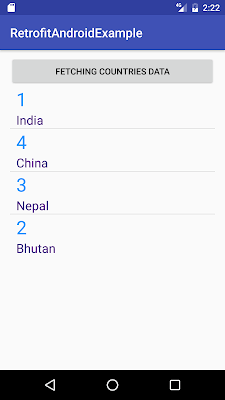
Lets code this example now:
Source code:
Step 1 :Creating Project
Create an android application project named “RetrofitAndroidExample”.
Step 2 : Add Retrofit and json gradle dependency
apply plugin: 'com.android.application'

android {
    compileSdkVersion 25
    buildToolsVersion "25.0.0"
    defaultConfig {
        applicationId "com.java2blog.retrofitandroidexample"
        minSdkVersion 15
        targetSdkVersion 25
        versionCode 1
        versionName "1.0"
        testInstrumentationRunner "android.support.test.runner.AndroidJUnitRunner"
    }
    buildTypes {
        release {
            minifyEnabled false
            proguardFiles getDefaultProguardFile('proguard-android.txt'), 'proguard-rules.pro'
        }
    }
}

dependencies {
    compile fileTree(dir: 'libs', include: ['*.jar'])
    androidTestCompile('com.android.support.test.espresso:espresso-core:2.2.2', {
        exclude group: 'com.android.support', module: 'support-annotations'
    })
    compile 'com.android.support:appcompat-v7:25.0.0'
    // retrofit, gson
    compile 'com.google.code.gson:gson:2.6.2'
    compile 'com.squareup.retrofit2:retrofit:2.0.2'
    compile 'com.squareup.retrofit2:converter-gson:2.0.2'
    testCompile 'junit:junit:4.12'
}
Step 3 : Creating Layout
Change res ->layout -> activity_main.xml as below:
We have one button and listview. When you click the button, we are going to populate data in listview by calling restful web services and render it on the listview.
Step 4: Creating layout for Row
- Go to res -> layout
- right click on layout
- Click on New -> File.
- Create a file named “row_item.xml” and paste below code in row_item.xml.
Step 5 : Creating model object Country :
If you notice, we are getting Json array from restful web service which has 4 items. Each item have two attributes id and countryName. We are going to create country object for each item.
package com.java2blog.androidrestjsonexample;
public class Country{
    int id;
    String countryName;

    public Country(int i, String countryName) {
        super();
        this.id = i;
        this.countryName = countryName;
    }
    public int getId() {
        return id;
    }
    public void setId(int id) {
        this.id = id;
    }
    public String getCountryName() {
        return countryName;
    }
    public void setCountryName(String countryName) {
        this.countryName = countryName;
    }
}
Step 6: Creating BaseAdapter for ListView
package com.java2blog.androidrestjsonexample;

import android.app.Activity;
import android.view.LayoutInflater;
import android.view.View;
import android.view.ViewGroup;
import android.widget.BaseAdapter;
import android.widget.TextView;

import com.java2blog.androidrestjsonexample.Country;
import com.java2blog.androidrestjsonexample.R;

import java.util.ArrayList;

public class CustomCountryList extends BaseAdapter {

    private Activity context;
    ArrayList countries;

    public CustomCountryList(Activity context, ArrayList countries) {
     //   super(context, R.layout.row_item, countries);
        this.context = context;
        this.countries=countries;

    }

    public static class ViewHolder
    {
        TextView textViewId;
        TextView textViewCountry;
    }
    @Override
    public View getView(int position, View convertView, ViewGroup parent) {
        View row=convertView;

        LayoutInflater inflater = context.getLayoutInflater();
        ViewHolder vh;
        if(convertView==null) {
            vh=new ViewHolder();
            row = inflater.inflate(R.layout.row_item, null, true);
            vh.textViewId = (TextView) row.findViewById(R.id.textViewId);
            vh.textViewCountry = (TextView) row.findViewById(R.id.textViewCountry);
            // store the holder with the view.
            row.setTag(vh);
        }
        else {
            vh = (ViewHolder) convertView.getTag();
        }

        vh.textViewCountry.setText(countries.get(position).getCountryName());
        vh.textViewId.setText(""+countries.get(position).getId());

        return  row;
    }

    public long getItemId(int position) {
        return position;
    }

    public Object getItem(int position) {
        return position;
    }

    public int getCount() {

        if(countries.size()<=0)
            return 1;
        return countries.size();
    }
}
This class is used to populating data for ListVIew. getView method is get called for drawing each row.
Step 7 : Creating interface for making HTTP call using Retrofit.
package com.java2blog.retrofitandroidexample;
import java.util.List;

import retrofit2.Call;
import retrofit2.Callback;
import retrofit2.http.GET;

public interface CountryArrayAPI {

    /* @GET url is after Base_URL.
       We are going to get List of country as response.
    */
    @GET("/arpitmandliya/AndroidRestJSONExample/master/countries.json")
    public Call getCountries();
}
We have defined get request in above interface. We do not have to include base url, it is part after base url which we have use. We are going to get List of countries as response here.
Step 8 : Creating MainActivity
Steps for Retrofit call :
- Create retrofit instance using base url. Retrofit will implicitly use gson to convert JSON to corresponding object. You need to define gson library explicitly in Retrofit 2.0
Retrofit retrofit = new Retrofit.Builder() .baseUrl(BASE_URL) .addConverterFactory(GsonConverterFactory.create()) .build(); - Create api with retrofit's create method and call getCountries method.
CountryArrayAPI api = retrofit.create(CountryArrayAPI.class); Call
- call = api.getCountries();
- Enqueue the request and onResponse will get called if your call is successful else onFailure will get called.
Change src/main/packageName/MainActivity.java as below:
package com.java2blog.retrofitandroidexample;
import android.util.Log;
import android.app.Activity;
import android.app.ProgressDialog;
import android.os.Bundle;
import android.support.v7.app.AppCompatActivity;
import android.view.View;
import android.widget.AdapterView;
import android.widget.Button;
import android.widget.ListView;
import android.widget.Toast;
import java.util.ArrayList;
import java.util.List;
import retrofit2.Call;
import retrofit2.Callback;
import retrofit2.Response;
import retrofit2.Retrofit;
import retrofit2.converter.gson.GsonConverterFactory;
public class MainActivity extends AppCompatActivity {
private Button btnSubmit;
String responseText;
Activity activity;
ArrayList countries=new ArrayList();
private ProgressDialog progressDialog;
ListView listView;
//Base URL of our web service
public static final String BASE_URL = "https://cdn.rawgit.com";
@Override
protected void onCreate(Bundle savedInstanceState) {
super.onCreate(savedInstanceState);
setContentView(R.layout.activity_main);
activity = this;
btnSubmit = (Button) findViewById(R.id.btnSubmit);
listView = (ListView) findViewById(android.R.id.list);
btnSubmit.setOnClickListener(new View.OnClickListener() {
@Override
public void onClick(View v) {
countries.clear();
progressDialog = new ProgressDialog(MainActivity.this);
progressDialog.setMessage("Fetching countries data");
progressDialog.setCancelable(false);
progressDialog.show();
//Call WebService
getWebServiceResponseData();
}
});
}
protected Void getWebServiceResponseData() {
//Creating Retrofit rest adapter
Retrofit retrofit = new Retrofit.Builder()
.baseUrl(BASE_URL)
.addConverterFactory(GsonConverterFactory.create())
.build();
//Creating an object of our api interface
 CountryArrayAPI api = retrofit.create(CountryArrayAPI.class);
Call call = api.getCountries();
call.enqueue(new Callback() {
@Override
public void onResponse(Call call, Response response) {
try {
countries= (ArrayList)response.body();
if (progressDialog.isShowing())
progressDialog.dismiss();
// For populating list data
CustomCountryList customCountryList = new CustomCountryList(activity, countries);
listView.setAdapter(customCountryList);
listView.setOnItemClickListener(new AdapterView.OnItemClickListener() {
@Override
public void onItemClick(AdapterView adapterView, View view, int position, long l) {
Toast.makeText(getApplicationContext(),"You Selected "+countries.get(position).getCountryName()+ " as Country",Toast.LENGTH_SHORT).show(); }
});
} catch (Exception e) {
Log.d("onResponse", "There is an error");
e.printStackTrace();
}
}
@Override
public void onFailure(Call call, Throwable t) {
Log.d("Failure",t.toString());
}
});
return null;
}
}
Step 8: Add internet permission in AndroidManifest.xml
Copy following code:
Put it in AndroidManifest.xml
Done, we have added internet permission to AndroidManifest.xml. Your application must be able to access internet now.
Step 9 : Running the app
When you run the app, you will get below screen:
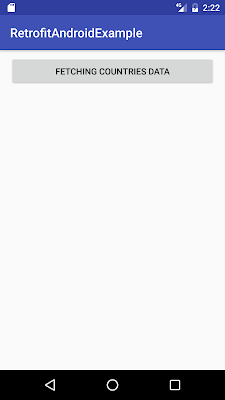
When you click on above button, you will get below screen.
We are done with Android Retrofit tutorial. If you are facing any issue, please comment.
